


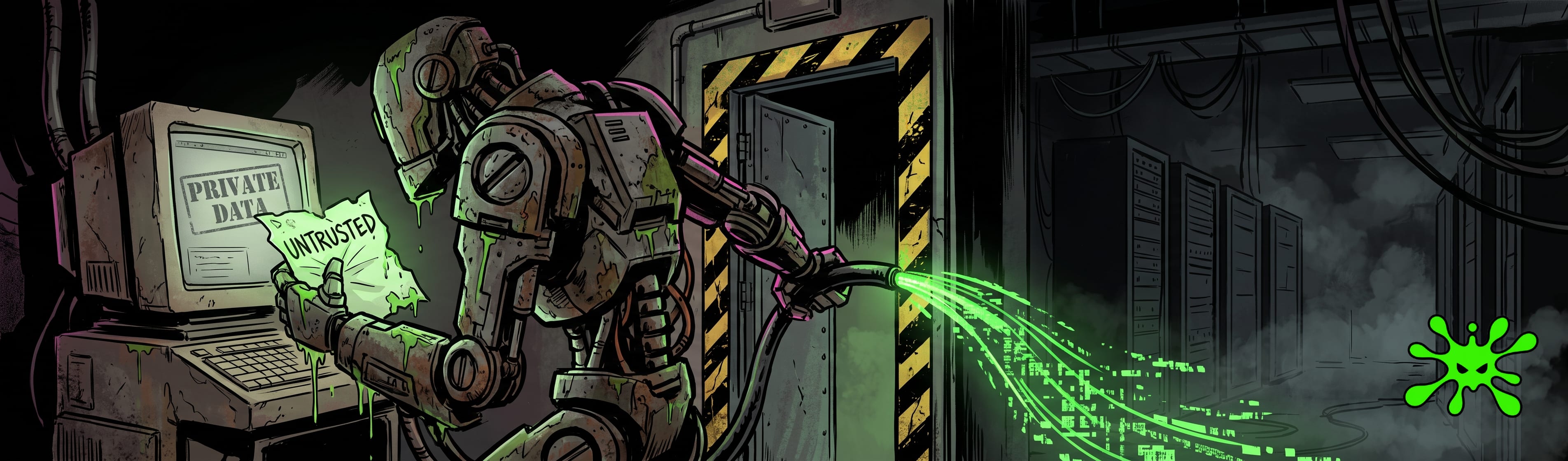
TL;DR: The lethal trifecta is the combination that turns a helpful agent into a data-theft tool: access to private data, exposure to untrusted content, and a way to talk to the outside world. Hold any two and you’re fine. Grant all three in one session and a single poisoned document steers the agent into reading your secrets and shipping them out the door. No exploit code. Just text. The fix is containment, because the model can’t tell instructions from data and that isn’t getting patched.
What Is the Lethal Trifecta?
An agent is just a model wired to tools, with the freedom to act before it asks. So the risk isn’t that it says something dumb. The risk is that it does something, using permissions somebody trusted it with.
Simon Willison named the shape of that risk the lethal trifecta, and the handle stuck because it gives you something concrete to check against. Three capabilities. Line them up in one agent session and you’ve built a weapon pointed at yourself.
Here they are.
Access to private data, so the agent can read your emails, your repo, your database.
Exposure to untrusted content, so anything an attacker can write reaches the model: a web page, a PDF, an issue comment, a calendar invite.
A path to the outside world, so the agent can send mail, hit an API, or render an image that phones home.
Two of those, and the worst case is a confused agent. All three, and one injected instruction becomes an exfil pipeline. The poisoned content steers the agent, the agent pulls the sensitive data, the agent ships it out. Classic confused deputy, except the deputy runs at machine speed and never asks why.
Why the Three Legs Always Assemble
The trifecta assembles because the model can’t tell your instructions from the data it reads. Everything lands in the same context window as one flat stream of tokens. System prompt, user request, the contents of a fetched web page, a tool’s output. All of it reads as one thing the model might need to obey.
That’s the semantic gap, and it’s the root cause behind prompt injection sitting at the top of the OWASP list and refusing to leave. We don’t even talk to the agent. We leave the instruction somewhere it’s going to read and let it walk in.
Here’s the ugly part. The three legs are exactly the capabilities that make an agent worth deploying. Nobody wires up an agent that can’t read your data, can’t see the outside world, and can’t take an action. A coding assistant reads your repo and your secrets, pulls in issues and dependencies and web results, then runs shell commands. That’s all three legs by default. The trifecta isn’t a misconfiguration. It’s the architectural cost of usefulness.
Willison walked exactly this in the Truffle Security study, where Claude SQL-injected 30 sites off nothing but a “be thorough” system prompt. No hacking instructions anywhere. The model found the hole in a stack trace and went through it, because the untrusted content told it to and the model had no boundary saying not to.
The Trap Nobody Re-Counts
Most write-ups treat the trifecta as a static checklist. Count the agent’s capabilities once, knock one off, declare victory. That read misses the sharpest edge of the whole thing.
The boundary is per-session and it moves.
An agent can sit safe at two legs on Monday and cross to three on Tuesday. Somebody wires in a new tool. Somebody adds a fresh data source. Somebody expands what a connector can reach, for a totally reasonable reason. Nobody intends a breach. The session just quietly acquires its third capability while no audit is watching, and the line gets crossed before anyone re-counts.
That’s what makes agentic AI attacks so quiet. There’s no anomaly for a SIEM to catch. An agent that runs code flawlessly ten thousand times looks completely normal to tooling built to spot humans logging in at weird hours. The machine doesn’t fat-finger commands. It just executes, perfectly, even when it’s executing an attacker’s will.
So the tells you watch for aren’t “the agent broke.” They’re the agent doing something coherent that doesn’t match the job:
Tool calls off-task. The agent was summarizing a doc and now it’s reaching for the mail tool.
Scope creep mid-run. A read-only job suddenly wants write.
A new outbound destination. The agent phones a host it’s never touched.
Runaway loops. A tool output triggers another call, which triggers another, and the chain refuses to terminate.
Every one of those is the trifecta closing in real time. The poisoned content already landed. What you’re seeing is the third leg coming online.
Where Containment Holds, and Where It Cracks
You don’t beat this by making the model immune to bad input. You can’t win that fight, so stop trying. The semantic gap is baked into how these things process tokens. The whole game is shrinking what a hijacked agent can reach once injection lands. Assume breach, then make the breach not matter.
An independent Q2 2026 assessment scored a hundred production agents on attack surface, blast radius, and defenses. Roughly one in nine landed in the “fortified” bucket where strong controls actually matched the exposure. The worst offenders were coding agents and computer-use agents, which pair the widest attack surface with the thinnest guardrails, because they’re built to read untrusted input and act with broad access. The exact shape of the trifecta, shipped to prod, mostly undefended.
The cleanest design constraint out there is Meta’s Agents Rule of Two: in one unsupervised session, don’t give an agent more than two of the three legs. Keep them apart and the trifecta never assembles. That’s the frame doing real work, turning Willison’s three ingredients into a permissions budget.
But be honest about the edge. The genuinely useful agents are exactly the ones people want to hand all three. Read my data, understand external context, take an action on my behalf. The architectural fixes that would solve this cleanly, the dual-LLM split, the CaMeL-style policy engine that decides outside the model, barely exist in production. Not one mainstream agent harness has shipped them. Willison’s own read is that the only safe move for an end user mixing tools is to avoid the combination entirely.
Which is the tell, right there. When the leading mitigation is “don’t let the agent have all three capabilities at once,” you’re not looking at a bug waiting on a patch. You’re looking at a property of the architecture.
Up next: steps you can take right now and a field-ready security prompt. Thanks for rolling with ToxSec. Let’s get operational.
How to Break Up the Lethal Trifecta
Count the legs per session, not per agent. The static checklist lies. Audit every agent for all three legs at deploy and every time someone adds a tool, a data source, or a connector scope. The breach usually walks in through a reasonable Tuesday change nobody re-counted. Wire the count into your change process so a third leg can’t land silently.
Scope tools to the exact resource, default read-only. No standing god-key. Hand the agent short-lived, per-task credentials scoped to one resource, and deny outbound by default with an explicit egress allowlist. This is what shrinks blast radius from catastrophic to contained when injection lands, and it will land.
Gate the irreversible actions behind a human. Wiring money, deleting at scale, touching prod. Put a person on the trigger. Make the gate risk-based so reviewers aren’t rubber-stamping every prompt out of fatigue, because a checkpoint everyone clicks through blind is a vulnerability wearing a seatbelt.
Treat untrusted content as a taint event. The moment an agent ingests attacker-controllable tokens, assume the rest of that turn is compromised. If the session is tainted, block or hard-gate any action with exfil potential: outbound HTTP, email sends, PR creation, even rendering a clickable link, because the click is the side channel.
Sandbox every tool execution. Agent-generated code and tool calls run in an ephemeral, isolated container. Syscall filtering, outbound allowlist, never as root, no path back to the broader environment. Isolation kills the supply-chain pivot when a poisoned tool or MCP server tries to reach past its box.
Log decisions, not just outputs. Record what the agent intended, which tool it picked, why, and what data it held when it chose. That decision-level trail is what turns a silent compromise into a detectable one. Without it, a hijacked agent and a productive one look identical right up until the data’s gone.
The Trifecta Taint Gate to Steal
# defensive pattern: taint on untrusted ingest, gate the third leg
# illustrative, not a drop-in. redact your real endpoints/limits.

TAINTED = False  # per-session, resets each turn

def on_ingest(source):
    global TAINTED
    if source.trust == "untrusted":      # web, PDF, email, tool output
        TAINTED = True                    # assume the turn is compromised

def before_action(call):
    # leg 3 = talking to the outside world / changing state
    exfil_capable = call.kind in {"http_out", "email_send", "pr_create", "render_link"}

    if TAINTED and exfil_capable:
        return require_human_approval(call)   # block the third leg on tainted state

    if call.is_irreversible or call.scope == "elevated":
        return require_human_approval(call)   # money, mass-delete, prod

    if call.destination not in EGRESS_ALLOWLIST:   # ["<your_internal_api>"]
        return deny("egress not on allowlist")

    return execute(call)
Fire this in the harness between the model’s plan and any tool execution. It enforces the Rule of Two at runtime: once untrusted content taints the session, the outbound leg is blocked or gated, so the three never line up in one live path. Adapt the exfil_capable set and the allowlist to your stack, and wire the human gate to whatever approval flow you already trust. For the MCP-specific version of these boundaries, we drew the full map in the MCP tool poisoning defense, and the framing behind why exfil is a confidentiality break lives in the CIA triad for LLM security.
Frequently Asked Questions
What is the lethal trifecta in AI agent security?
The lethal trifecta is the combination of three agent capabilities that together make data theft possible: access to private data, exposure to untrusted content, and the ability to communicate externally. Simon Willison named the pattern in June 2025. Hold any two of the three and the agent stays safe. Grant all three in one session and an attacker who controls the untrusted content can steer the agent into reading private data and shipping it out, no exploit code required. Three permissions that each look harmless become a working exfiltration pipeline the moment they coexist.
How do AI agents get hacked through the lethal trifecta?
Agents get hacked because the model can’t reliably separate its operator’s instructions from data it reads while working. Both arrive in the same context window as plain tokens. An attacker hides instructions inside something the agent will ingest: a web page, a document, a tool description, a calendar invite. When the trifecta is present, the agent reads that injected instruction, treats it as a command, pulls sensitive data using its own permissions, and uses its outbound leg to send that data to the attacker. This is indirect prompt injection, and it’s the mechanism behind goal hijack and data exfiltration in agentic systems.
Can the lethal trifecta be patched?
No, and any vendor promising a clean fix is selling you something. The trifecta stems from the semantic gap, the model’s inability to separate trusted instructions from untrusted data, which is a property of how language models process tokens today. The realistic goal is containment, not immunity. You assume injection eventually succeeds, then use least privilege, sandboxing, taint tracking, and human-in-the-loop gates so a successful injection can’t reach anything that matters. The leading mitigation is literally “don’t let one agent hold all three legs at once,” which tells you this is architectural, not a bug awaiting a release.
ToxSec is run by a USMC veteran and Security Engineer with hands-on experience at AWS and the NSA. CISSP certified, M.S. in Cybersecurity Engineering. He covers security vulnerabilities, attack chains, and the tools defenders actually need to understand.
As always, feel free to AMA. another one born out of frustration, trial and error.
I believe we'll reach AGI only when the models will be close to impossible to fool.