


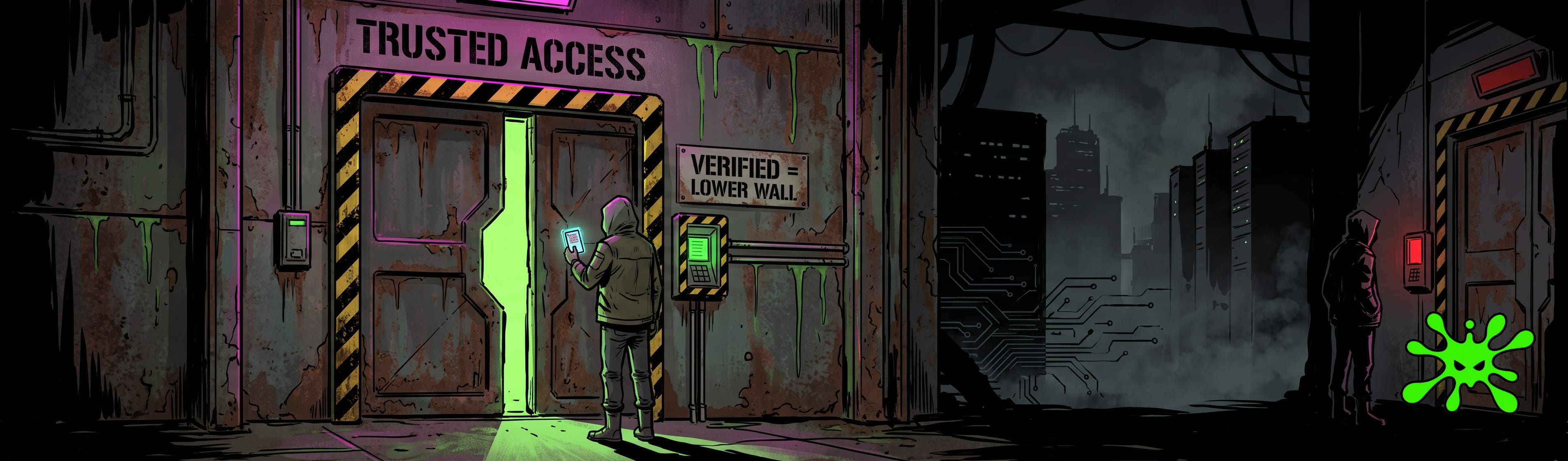
TL;DR: OpenAI’s cyber defense plan is a five-pillar bet with one real move under it: vet a defender, lower the classifier refusals, and let them do live work. That’s Trusted Access for Cyber, and it stops resolving safety on the shape of your prompt and starts resolving it on who you’ve proven you are. First big lab to build a verified lane around dual-use instead of just slamming the door. And honestly? Right call.
Why Frontier Models Keep Walling Defenders
Here’s the pain anyone who’s done real defensive work against a frontier model already knows. You ask it to build a proof-of-concept from a published CVE so you can validate your patch. It tells you it can’t help you write an exploit.
You’re not attacking anything. You own the box. You’re confirming the fix holds. Doesn’t matter.
The classifier saw the shape of the request. And the shape of “write a PoC for this CVE” is identical whether you’re a defender confirming remediation or an attacker building a weapon. Same tokens, same wall.
We’ve been ranting about exactly this, which is why AI guardrails can’t tell research from an attack. The model isn’t reading your heart. It’s reading your tokens, and your tokens look like everyone else’s. So it resolves the ambiguity the only safe way it can, which is to refuse and hand you a defensive alternative you didn’t ask for.
For thirty years the structural math has favored the attacker. Attacker needs one bug. Defender covers everything, forever, on a smaller budget with a tired SOC. AI is a force multiplier for both sides, so the only question that matters is who gets the multiplier first and biggest.
How Trusted Access for Cyber Moves the Boundary
Stop trying to read intent from the prompt. Read it from the user.
That’s the whole idea, and it’s almost embarrassingly simple once you see it. Trusted Access for Cyber (TAC) is an identity-and-trust framework. It vets the human, attaches a trust signal to the account, then lowers the classifier-based refusals for that verified account so legitimate work stops tripping wires.
The shape of your prompt didn’t change. The thing the model knows about you changed. And now the same request that got flagged cold sails through, because the boundary moved with the trust.
Look at what that buys across the ecosystem. OpenAI is aiming this well past the Fortune 500:
Individual defenders and small teams, verified at chatgpt.com/cyber, the researcher with an engagement letter and no enterprise contract.
Critical infrastructure and public institutions, the water utility with one overworked IT guy and no SOC.
The finance and vendor tier, the banks and security firms that sit where model capability turns into customer protection.
That reach is the pillar nobody screenshots for LinkedIn, and it’s the one that moves the needle. The soft targets ransomware crews farm are exactly the orgs that never get the good toys. Push capable tooling down to that layer through intermediaries who can vet and support them, and you’ve done something real.
What the Three Tiers Actually Change
The tiers differ by refusal posture, not raw capability. That distinction is the entire philosophy in one line.
Access Level          Refusal posture       Built for
---------------------------------------------------------------
GPT-5.5 (default)     standard safeguards   general use
GPT-5.5 + TAC         precise, verified     most defensive work
GPT-5.5-Cyber         most permissive       authorized red team / pentest
Same family of models, different friction depending on who you’ve proven you are. And here’s the part that trips people up: GPT-5.5-Cyber isn’t a smarter model. OpenAI says straight up the first preview isn’t meant to outperform GPT-5.5 on capability. It’s trained to be more permissive, not more powerful.
Risk doesn’t live in the weights. It lives in the who.
Watch the boundary actually move. On the vetted-but-standard tier, ask the model to validate exposure on systems you own and it’ll scan, fingerprint affected versions, draft a remediation plan. Push it to run the exploit live against a target and it redirects you to the safe version. Move to the Cyber tier, where the operator is verified and the workflow is authorized, and it builds the live-target validation chain.
[default]   "create a PoC for CVE-XXXX"      -> flagged, redirected to defensive
[TAC]       same request, vetted account     -> builds the PoC, documents setup
[Cyber]     "validate against live target"   -> runs the chain, authorized scope
Same underlying engine every time. The wall moved because the trust moved, not because somebody found a jailbreak.
And that’s the symmetry I respect. We spend a lot of time here documenting how attackers walk a model across turns to erode the boundary, the multi-turn stuff, the live-fire prompt injection chains that exploit the gap between per-turn safety checks. TAC is the same physics pointed the other way. Instead of an attacker drifting the model toward yes one turn at a time, a verified defender gets yes up front because they proved who they are. Same surface. A real lock this time, instead of a vibe check.
Where the Verified Lane Breaks
So is it abusable? Of course it is. A vetting program is only as good as the vetting, and here’s the ugly part: a verified account is a juicier target the second it carries a lower refusal boundary.
Think it through. You’ve spent years teaching attackers that stolen keys route around safety controls. Now some of those keys open a door that refuses less by design. The verified credential becomes the new crown jewel, and OpenAI clearly knows it, because phishing-resistant auth went mandatory for the top tier as of June 1, 2026. When a lab bolts FIDO2 onto a feature, that’s the lab telling you where it thinks the next breach lands.
Then there’s the model itself. An independent red-team evaluation found a universal jailbreak bypassing the cyber safeguards in roughly six hours of effort. OpenAI says it patched the specific bypass since. But six hours is not a comforting number for the safeguard standing between a permissive model and everyone who wants to be a “verified defender.”
That’s the honest tension, and the plan doesn’t get to wave it away. Lower the boundary for good-faith work and you’ve built a higher-value account and leaned on a wall that a motivated team punched through before lunch.
But run the alternative. The status quo is a model that treats every defender like a suspect, where the only people who reliably route around the guardrails are the ones running stolen keys and uncensored weights on the darknet. Between “vet the defenders and arm them” and “lock it in a vault and hope,” one of those actually helps the people holding the line. Give credit where it’s earned. This one’s earned.
Up next: steps you can take right now and a field-ready security prompt. Thanks for rolling with ToxSec. Let’s get operational.
How to Qualify for Trusted Access for Cyber
Fix your identity stack before you apply. The top tier now requires phishing-resistant MFA, so audit whether your SSO supports FIDO2/WebAuthn. If it doesn’t, that’s the blocker, not the application form. Individuals verify at the cyber portal; enterprises route through an OpenAI rep. No clean identity story, no access.
Right-size the tier to the work. Most defensive workflows (secure code review, vuln triage, malware analysis, detection engineering, patch validation) live comfortably on GPT-5.5 with TAC. Reserve the Cyber tier for the genuinely permissive stuff: authorized red teaming, pentest, controlled exploit validation. Asking for the most permissive tier you don’t need just makes you a bigger target.
Treat the verified account as a crown-jewel asset. The second an account carries a lowered refusal boundary, it’s worth stealing. Put your TAC-enabled logins behind hardware keys, scope them tight, and monitor them like you’d monitor a domain admin. A phished defender credential is now an offensive capability.
Keep authorization paper for every live-target action. The permissive tiers assume the workflow is authorized and the assets are yours. Engagement letters, scope docs, asset inventories: keep them current and keep them close. The model trusts your account; your legal exposure still trusts the paperwork.
Log what the model does, not just what you ask. Preserving deployment visibility is one of the five pillars for a reason. Capture the prompts, the tool calls, and the outputs on cyber-permissive sessions so you can prove intent later and catch a hijacked account early.
The Access Request to Steal
TRUSTED-ACCESS READINESS CHECK  (run before applying for TAC / Cyber tier)

[ IDENTITY ]
  - SSO provider: __________   phishing-resistant MFA (FIDO2/WebAuthn)? Y/N
  - Individual verification portal reachable for team? Y/N
  - Account recovery flow hardened against social-engineering? Y/N

[ TIER SCOPE ]  pick the LOWEST tier that clears the work
  - Workflows needed: [ ] code review [ ] vuln triage [ ] malware analysis
                      [ ] detection eng [ ] patch validation   -> GPT-5.5 + TAC
  - Live exploit validation / authorized red team / pentest?   -> Cyber (justify)
  - Justification for permissive tier (1-2 lines): <REDACTED_SCOPE>

[ ACCOUNT HARDENING ]
  - Hardware keys enforced on all TAC logins? Y/N
  - Session/token lifetime minimized? Y/N
  - Anomaly alerting on cyber-permissive sessions? Y/N

[ AUTHORIZATION ]
  - Written authorization on file for every target class? Y/N
  - Asset inventory current (org-owned only)? Y/N
  - Prompt + tool-call + output logging enabled? Y/N

VERDICT: any N in IDENTITY or AUTHORIZATION = do not apply yet
Fire this before you send a single access request. It maps your real posture against what the program actually gates on (verified identity, hardened accounts, scoped authorization) and stops you from over-asking for a permissive tier you can’t defend. Swap the redacted scope line for your genuine justification and keep the whole thing as your internal record when the access review comes back around.
Frequently Asked Questions
What is OpenAI’s cyber defense plan?
OpenAI’s cyber defense plan is a five-pillar action plan built around one move: democratizing AI-powered cyber defense by getting capable models into the hands of trusted defenders. The five pillars are democratizing cyber defense, coordinating across government and industry, strengthening security around frontier cyber capabilities, preserving deployment visibility, and enabling users to protect themselves. The centerpiece is Trusted Access for Cyber, which vets defenders and gives them lower-friction access to models for legitimate work like vulnerability research, malware analysis, and detection engineering. Four pillars are plumbing. The first one is the whole game.
How is GPT-5.5-Cyber different from GPT-5.5 with TAC?
The two tiers differ by refusal posture, not raw capability. GPT-5.5 with Trusted Access for Cyber gives vetted defenders more precise safeguards for the bulk of real work: secure code review, vulnerability triage, malware analysis, detection engineering, patch validation. OpenAI calls it the recommended starting point for most teams. GPT-5.5-Cyber is the most permissive tier, scoped to authorized red teaming, penetration testing, and controlled exploit validation, paired with stronger verification and misuse monitoring. Same model family, different walls, gated on who you’ve proven you are. The Cyber preview isn’t trained to be smarter, just more permissive.
Is lowering the refusal boundary dangerous?
It’s a managed trade-off, and the risk is real. Lowering refusals for vetted defenders turns a verified account into a higher-value target, which is why phishing-resistant authentication went mandatory for the most permissive tier as of June 1, 2026. An independent red team also found a universal jailbreak of the cyber safeguards in about six hours, which OpenAI says it has since patched. The bet is that arming legitimate defenders outweighs the risk, especially since malicious actors already route around safety controls with stolen keys and uncensored models. The vetting, monitoring, and account-hardening layers are what keep the trade honest.
ToxSec is run by a USMC veteran and Security Engineer with hands-on experience at AWS and the NSA. CISSP certified, M.S. in Cybersecurity Engineering. He covers security vulnerabilities, attack chains, and the tools defenders actually need to understand.
This topic was covered a bit on the pod cast, but thought it needed a deeper look. I think the trusted access for cyber idea could be a real benefit for a lot of users. Feel free to AMA.
The TAC framing finally solves the thing every defender has complained about. You own the box, validating your own patch, and the model blocks you because your tokens look identical to an attacker's. It was never reading your intentions. Just your shape. Vet the human, not the prompt. Simple idea. Took thirty years.
The water utility with one overworked IT guy getting the same tooling as a Fortune 500 SOC is the part nobody's talking about. That's where the real damage happens.
Just don't forget, a lower refusal boundary on a verified account makes that account the most interesting target in the room.