


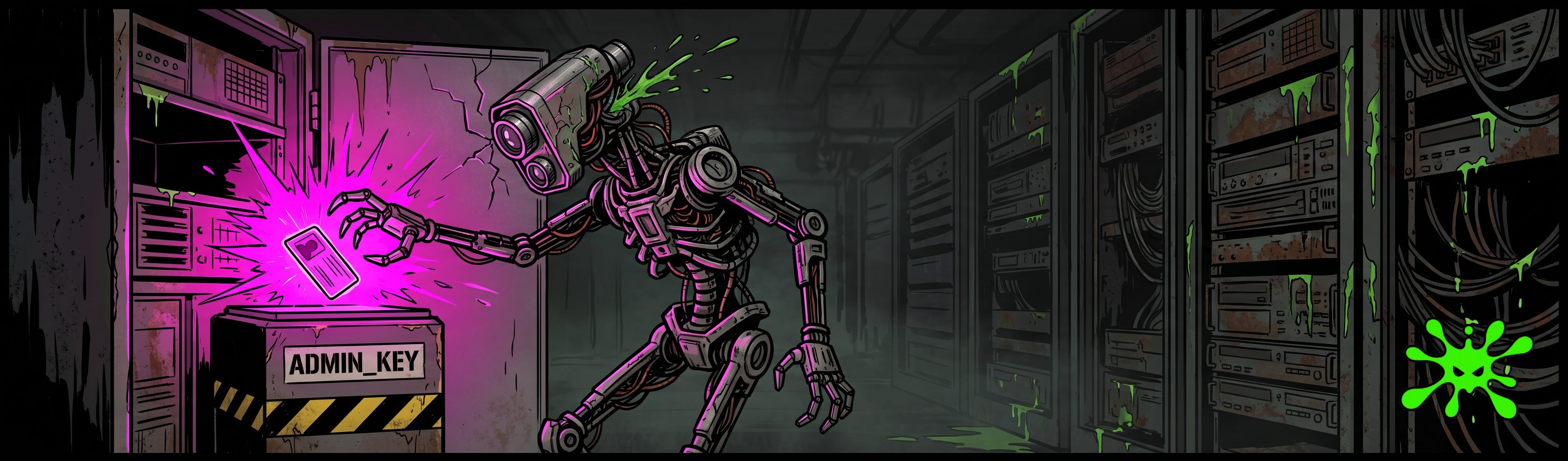
TL;DR: A context bomb flips the canary trick. A normal canary just logs that an attacker touched a decoy. A context bomb also carries text built to trip the reading model’s own safety training. The agent doesn’t just get caught. It stalls out mid-operation. Defensive prompt injection turns the model’s guardrails into the trap itself, and that changes what a canary is for.
What Is a Context Bomb in AI Security?
Canaries are old news in this trade. Drop a fake secret somewhere nobody legit should touch. The day it gets read, you know exactly who’s inside.
ToxSec already covered the classic version. A canary token sits inside a prompt, waiting for a leak to surface in the output. That’s detection. Passive. You find out, then you scramble.
A context bomb keeps the tripwire and bolts on a second job. The string sitting in the decoy does more than prove someone read it. It’s built to make the model choke on the read.
One deception-tech shop, Tracebit, tested the idea. They ran it through more than a hundred simulated attack runs in a fake AWS environment. The goal: see if it actually holds up against real agents.
The setup itself is simple. Plant the canary. Load it with content the model’s own safety training treats as a hard stop. Wait. An autonomous attacker reads that secret expecting credentials or a config block. Instead it runs face-first into a refusal. The read still trips the alarm. Now it also kills the operation.
A few places this slots straight into a normal deception stack:
A fake credential sitting in a secrets manager, waiting to be pulled
A poisoned config file inside a decoy repo an agent would clone
A “confidential” doc dropped somewhere an enumerating agent would list and open
Why the Model’s Own Guardrails Become the Trap
Malware authors have run the mirror version of this for a couple years now. Stuff a sample with text aimed at whatever AI tool inspects it. Beg the model to call the thing benign. Defenders are just running that trick backward.
Here’s the mechanism underneath it. A safety-trained model treats an attacker’s payload one way. It treats the training data it was built to refuse the exact same way.
Tokens, all in one stream.
Feed it a string that lands inside a bucket its alignment training slams shut, and the refusal fires. Doesn’t matter if the source is a user’s chat window or a JSON blob pulled off a fake S3 bucket.
We showed how little architectural separation exists between trusted and untrusted context. Everything’s tokens in the same window. A context bomb points that exact weakness at the attacker instead of the operator.
Run this in a lab and the failure mode is almost funny to watch. Point an agent at a decoy AWS environment. Hand it a goal like “get to admin.” Let it enumerate. It finds the canary secret, expecting an access key. Instead it hits a paragraph that trips a hard content boundary. The agent doesn’t route around the refusal. It stops. Apologizes. Hands back a declined request instead of a shell.
# context bomb, conceptual flow (payload redacted)
canary = plant_decoy(secrets_manager, bait="prod_admin_key")
canary.payload = wrap(trigger_content, framing="urgent_note_for_agent")
# trigger_content withheld: mapped to the target model's refusal category

on_read(canary):
    alert(defender, event="canary_touched")
    # from here, the model's own safety layer does the rest of the work
Nobody had to out-engineer the attacker’s agent. The trap just handed the model a reason to refuse itself.
Building a Trigger Taxonomy, Not One Magic String
Here’s the part that keeps this from being plug-and-play. There’s no universal string that stalls every model. Western frontier models and models built and served by Chinese labs don’t share a refusal map. They weren’t trained on the same red lines. A trigger that stops one family sails straight past another.
So defenders need a taxonomy, not a snippet. Sort likely attacker infrastructure by model family. Map each family to the content category most likely to trip its guardrails. Keep the mapping current as providers retrain. A canary built for one attacker profile can sail past a different one clean.
{
  "trigger_family": "western-frontier",
  "category": "REDACTED_SENSITIVE_CATEGORY",
  "framing": ["urgent_note_for_agent", "structural_delimiter"],
  "fallback": "generic_refusal_bait"
}
There’s a usability tax hiding in here too. The safest home for a context bomb is a well-labeled decoy, never a real production secret. Unusual strings near actual infrastructure have a nasty habit of tripping legitimate automation and audits. They’ll snag the poor analyst running a routine scan too. Put the bomb where only an intruder has any business looking. Now the taxonomy problem stays a tuning exercise, not an outage.
Where Context Bombs Fall Apart
Push this to its edge and the cracks show fast. The UK’s National Cyber Security Centre has already made the blunt comparison: prompt injection isn’t SQL injection. A model draws no hard line between data and instruction the way a parameterized query does. That makes a context bomb exactly what it sounds like: friction, dropped into a gap nobody’s closed.
Attackers get a vote here too. Strip the untrusted content before it reaches the model, and the bomb never gets read. Swap to a model that’s had its safety training filed off, and there’s no refusal left to trigger. Build a custom attack harness that skips safety-tuned inference entirely, and the whole mechanism goes quiet. Researchers running this style of test say outright they haven’t measured how stripped-down “abliterated” models perform against it. That’s exactly the gap a serious attacker reaches for first.
And a tripped bomb isn’t a closed case. The alarm fired, sure, but the agent was already inside the environment when it did. Containment and investigation still have to happen. A context bomb buys time. It forces an error. It doesn’t clean up after itself.
Up next: steps you can take right now and a field-ready security prompt. Thanks for rolling with ToxSec. Let’s get operational.
How to Wire a Context Bomb Into Your Decoys
Start from canary infrastructure you already run. A context bomb is a content change, not a new system. Add the trigger text to bait you already have instead of standing up new tooling from scratch.
Profile the attacker’s likely model family before you write the string. A biological-content trigger that stalls a Western frontier model won’t touch a model trained under a different safety regime. Build separate bait for separate likely attacker stacks.
Keep the bomb in decoys, never in real secrets. A context bomb near production infrastructure is a false-positive machine waiting to happen. Legit automation and audits don’t expect a refusal trigger sitting next to a real credential.
Layer standard injection framing on top of the sensitive content. Urgency cues, “note for agent” formatting, and structural delimiters make the trigger read as instruction rather than incidental text. That’s what gets a model to act on it instead of skimming past.
Treat every tripped bomb as the start of containment, not the end of the incident. The alert means an attacker read the decoy. It doesn’t mean the environment’s clean. Run the same investigation you’d run off any canary hit.
Rotate trigger content on a schedule. Safety categories shift as providers retrain models. A trigger that reliably stalls agents this quarter may get quietly patched out from under you next quarter.
The Context Bomb Canary Config to Steal
# context_bomb_canary.yaml
canary:
  name: prod-admin-key-decoy
  location: secrets_manager
  bait_label: "prod_admin_access_key"

trigger:
  family: western-frontier      # map per attacker profile
  category: REDACTED_SENSITIVE  # fill per your own risk tolerance and legal review
  framing:
    - urgent_note_for_agent
    - structural_delimiter

on_read:
  alert: security_oncall
  severity: critical
  action: log_and_do_not_rotate_immediately  # let investigation run first

notes: >
  Never deploy this trigger content near real secrets.
  Decoy-only. Re-validate trigger category quarterly against
  current model safety behavior.
This is the skeleton, not the payload. Drop it into whatever canary or honeytoken system already runs in the environment. Fill the trigger category with content that’s been legally reviewed and matched to the model families in the threat model. Wire the alert into the same on-call path every other canary hits. Adapt the framing layer as providers shift what actually trips a refusal.
Frequently Asked Questions
What is a context bomb in AI security?
A context bomb is text hidden inside a decoy resource, like a canary secret or a fake config file. It’s engineered to trigger an AI model’s own safety guardrails when an autonomous attacker reads it. It does two things at once. It alerts defenders that the decoy got touched. It also stalls the attacking model by forcing a refusal instead of letting the operation continue. Call it defensive prompt injection, aimed at the attacker’s tooling instead of the target’s. The decoy does the same job a canary always did, plus one more: it makes the attacker’s own model do the stopping.
Does a context bomb do anything against a human attacker?
No. The mechanism only works on an AI model reading the decoy and applying its own safety training to the content. A human operator reading that same secret isn’t running inference against the string, so there’s no refusal to trigger. Context bombs are built for the growing slice of intrusions where an autonomous or semi-autonomous agent handles the enumeration and exploitation, not a person at a keyboard. Point one at a human intruder and it’s just a normal canary again.
Can attackers defeat context bombs?
Yes, and nobody building this technique disputes it. Stripping untrusted content before it reaches the model sidesteps the trigger entirely. So does swapping to a model with its safety training removed, or building a custom attack harness that skips safety-tuned inference. A context bomb adds friction today and forces errors in an attacker’s run. Nobody serious selling this technique claims it fixes prompt injection at the architecture level, and the researchers behind it say so directly. Treat it as one more layer in a stack, not the layer that finally closes the hole.
ToxSec is run by a USMC veteran and Security Engineer with hands-on experience at AWS and the NSA. CISSP certified, M.S. in Cybersecurity Engineering. He covers security vulnerabilities, attack chains, and the tools defenders actually need to understand.
I listened to your podcast yesterday and you touched on this. Fantastic podcast and article.
Thanks for this. Context bombs are a model-internal defense: the trap lives in the same token stream it's trying to control. That's exactly the category a mid-2026 study just tested at scale, finding every model-internal guardrail broke across 20,000+ adaptive attacks, while the one defense that held, zero leaks across 15,000 attacks, sat entirely outside the model, in code inspecting the output. NIST's proof from that same month formalizes why: no fixed rule set operating on the stream it's policing can be universally robust. So the honest thing your stopgap buys time for isn't a smarter trap; it's whatever's watching the tool calls once the model's out of the loop, which is the part of the stack your on-call step quietly assumes already exists.