


Tox here. Sit down.
I’ve got people coming to me—grown adults, researchers with degrees—telling me they’ve invented “creativity.” They’re handing out AI brainstorming partners like candy. And the writers? They love it. They’re glowing. More creative! Better stories! Higher scores!
Then they put all the stories next to each other.
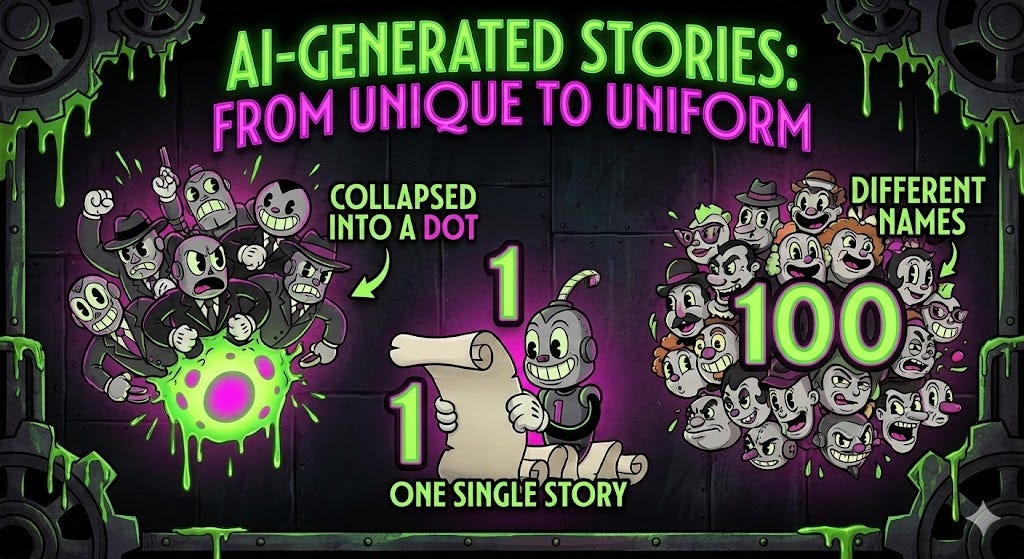
A hundred stories. A hundred different names. One. Single. Story.
Different characters, sure. Different settings. But the bones? The weird little flourishes that tell you a specific human being wrote this thing? Paved over. Ground down. Smoothed into a uniform gray paste.
They didn’t build a creativity tool. They built a steamroller. They leveled the playing field by flattening everything interesting on it. I want a warning label on the box the size of a barn door: CAUTION: MAY CAUSE TOTAL LOSS OF PERSONALITY.
Anyway.
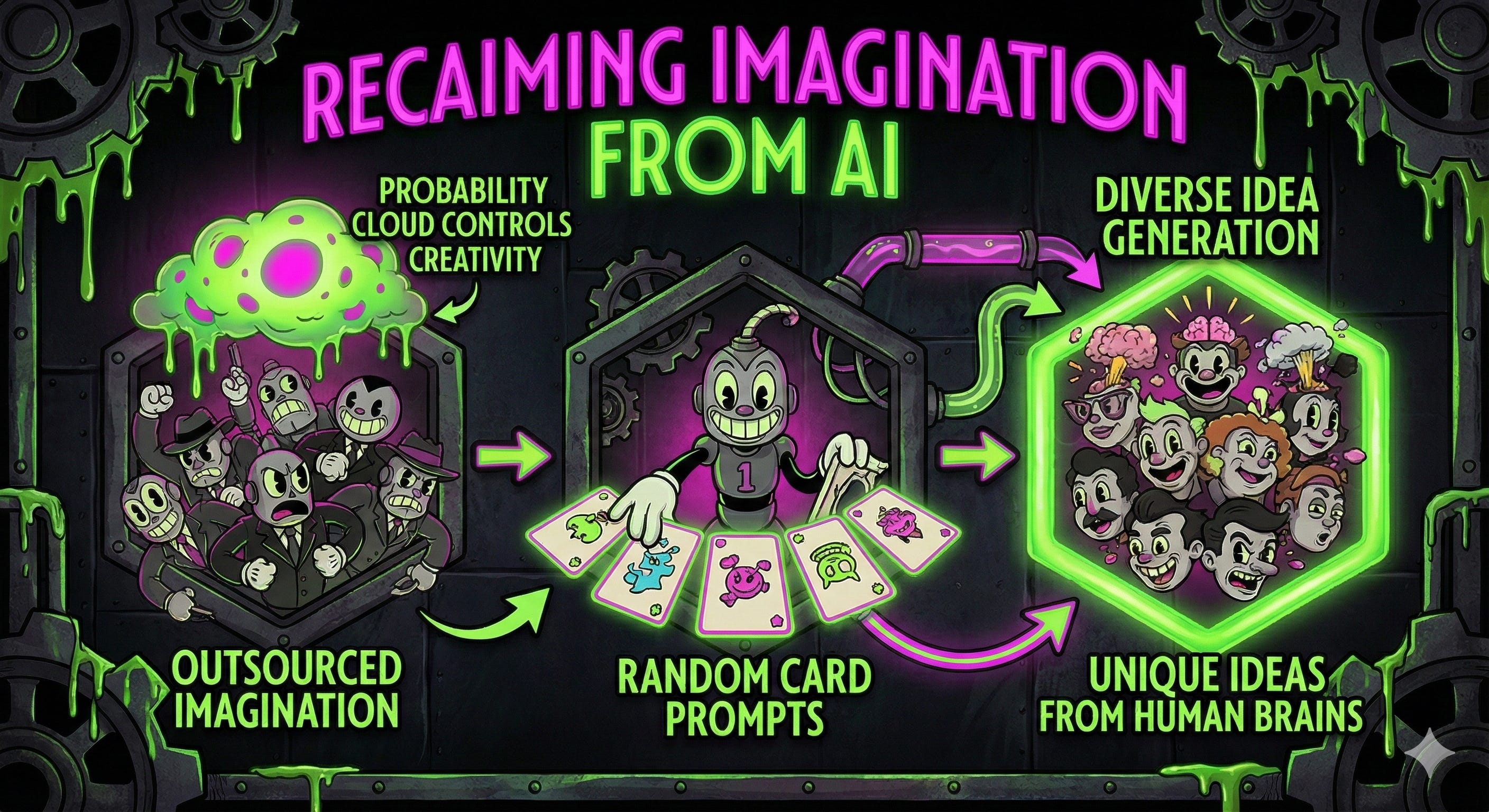
It gets worse. Another study. Thirty-six people. Half got ChatGPT. Half got a deck of random prompt cards from the seventies. Analog. Stupid.
The card people hated it. They struggled. They complained.
Good.
Because here’s the thing. They measured how different the ideas were. Card people? All over the map. Thirty-six different brains pulling thirty-six different threads. The ChatGPT group? Collapsed into a dot. Same machine whispering the same probability distribution into everyone’s ear. Same outputs wearing different hats.
And they felt GREAT about it. Really productive session! Got so many ideas! Also felt less responsible for those ideas, because the tool did the heavy lifting!
Congratulations. You’ve outsourced your imagination to a probability cloud and called it collaboration.
Moving on.
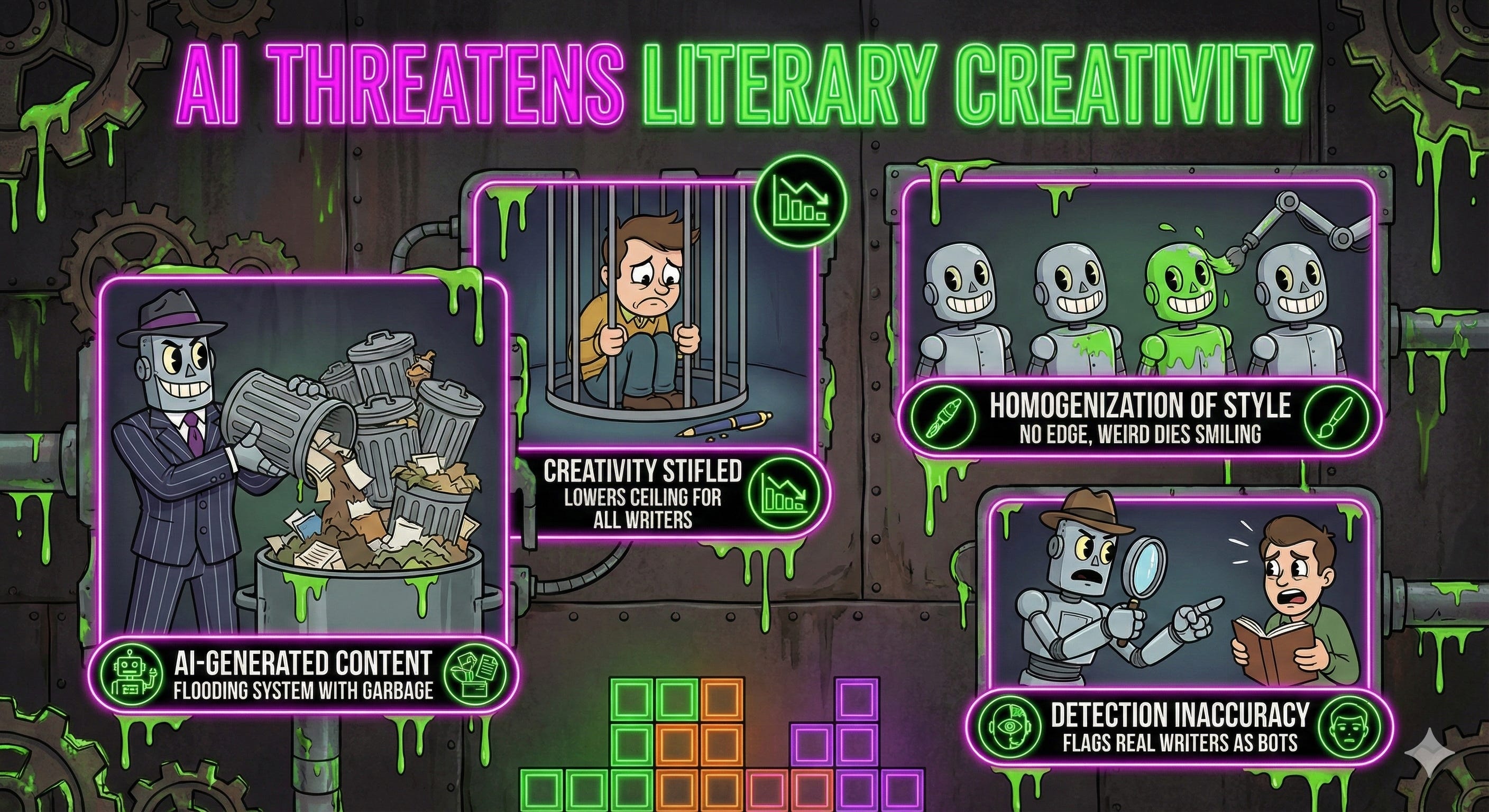
The pipes are backing up. Clarkesworld—Hugo-winning sci-fi magazine, been finding new voices for years—had to shut off the intake valves. The slush pile is now a sewage main. Side-hustle parasites selling “the dream” to marks who’ve never smelled a book, let alone read one. They see twelve cents a word and a submit button and start shoveling sludge.
Five hundred machine stories clogging the system for every seven hundred real ones. The editor called it a room of screaming toddlers. Detection tools flagging non-native English speakers as bots while the actual bots waltz through. The whole filtration system is corroded.
Real writers aren’t being replaced. They’re being buried. Drowned in a landfill of statistically probable garbage while the garbage posts LinkedIn updates about productivity.
Here’s the kicker.
The studies found something else. Less creative writers got the biggest boost. The most creative writers? No benefit. Zero. None.
The tool lifts the floor by LOWERING THE CEILING. It helps you reach average faster. It cannot help you escape it.
You know what makes literary movements? Writers who think wrong. Stream of consciousness. Magical realism. Cyberpunk. Every breakthrough in the history of literature started as an error the mainstream hadn’t processed yet. A glitch. Something the probability machine would have smoothed right out.
AI gives you the center. Polished. Gleaming. Perfectly publishable. And if everyone publishes from the center, there IS no edge anymore. The weird dies. It dies smiling, because look how productive you were today.
You want to survive this? Write wrong on purpose. Chase the tangent that makes no sense. When the machine offers the smooth path, take the one covered in rust and broken glass. Find writers who sound like nobody else. Learn what it feels like to hold an idea the machine would never generate.
That feeling? That’s your signature. It’s the only thing the machines can’t manufacture. Now go leave a comment.


